
Description:
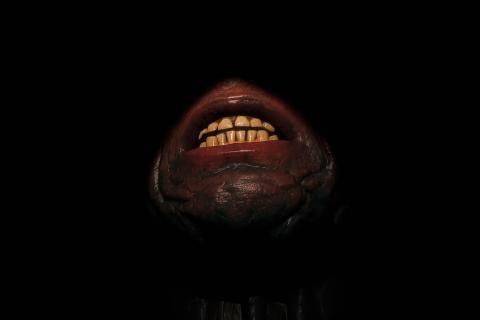
Not I VR re-stages Samuel Beckett’s 1972 monologue for a lone, disembodied mouth inside an immersive, single-user virtual-reality installation. The project asks how Beckett’s radically subtractive dramaturgy – extreme darkness, torrent of words, singular, focused scenography – behaves within an additive, real-time engine driven by motion capture, spatial audio and digital doubles. Developed through practice-as-research, the piece investigates presence, authorship and posthuman embodiment at the intersection of theatre, XR design and performance studies.
The visitor undergoes a short onboarding rite; they remove shoes, don the HMD and a hooded black djellaba and step bare-foot onto grass (either real or synthetic), embodying Beckett’s elusive “Auditor” character. Inside the VR world, the participant confronts an enlarged, elevated Metahuman mouth, animated by Live Link capture of professional actor (Brenda Meaney) delivering Beckett’s text at the prescribed rapid tempo. Meta XR Spatial Audio pins each syllable in three-dimensional space, while a tight spotlight and ambisonics continually draw the audience’s gaze, sustaining the work’s claustrophobic focus. Although the user has 6 degrees of freedom (6DoF) of movement, locomotion is confined to a restricted, semicircular zone in front of Mouth, subverting VR’s usual ethos of free exploration and amplifying Beckett’s intended aesthetics of entrapment.
Not I VR offers and original contribution to the genre of restaging and readapting Beckett's writing by (1) demonstrating how canonical theatre can be transformed through off-the-shelf real-time technologies; (2) offering a rigorously documented example of “subtractive dramaturgy” within an immersive medium; and (3) foregrounding ethical and scholarly questions about digital twins, authenticity, and spectatorship in post-truth culture.
Technical Setup (Installation Specs)
Technically, the installation runs on Steam VR and Meta Quest Link, a single RTX-class workstation, and one tethered HMD; the physical footprint is a 3m × 3m draped booth requiring 220V AC power and minimal ambient light.
Not I VR is a single-user experience built in Unreal Engine 5.5 and packaged as a stand-alone OpenXR application. The cooked build runs comfortably at 90 fps on a desktop‐class workstation equipped with an Intel i9-13900 K (or AMD Ryzen 7950X), 64 GB DDR5 RAM, and an NVIDIA RTX 4080-class GPU (16 GB VRAM). A fast NVMe SSD with at least 50 GB free space hosts the 5 GB executable and cached shader data. Windows 11 Pro is required for current Meta Link (v77) and SteamVR 2.x runtimes.
The exhibition runs best using a Meta Quest 3, tethered via Link cable, coupled with closed-back, noise-cancelling, over-ear headphones to preserve spatial-audio cues, particularly in noisy hall environments. A single HD monitor beside the host PC allows operators to supervise performance metrics, while a large wall-mounted TV (or projector) mirrors the headset view so queued visitors can follow the immersant’s journey. The complete system draws < 750 W from a standard 220 V supply; a four-socket surge-protected power strip is sufficient.
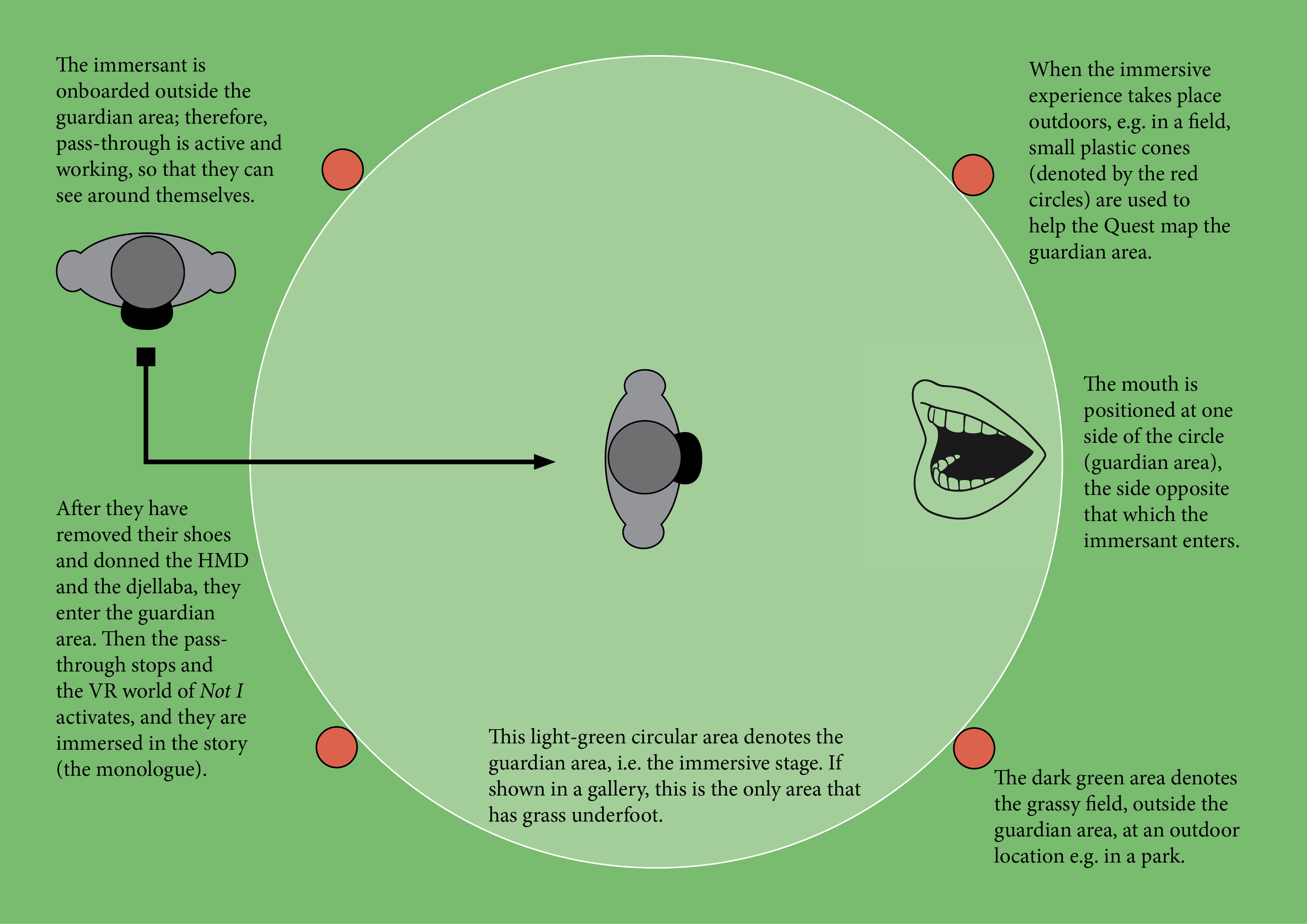
The installation optimally occupies a 2m x 2m floor area, with at least 2.5 m overhead clearance. At its centre sits a 2m-diameter circle of natural turf; if natural grass is infeasible, a sanitizable synthetic-grass mat substitute will suffice (see Fig. 1 below). Cables are routed through a low-profile cable bridge to eliminate trip hazards, and the workstation rests on a small pedestal or table positioned outside the performance area.
Onboarding Workflow
- Welcome & screening – the facilitator checks for motion-sickness tendencies and explains the five-minute experience.
- Ritual grounding – the visitor is invited into the space, sits on a chair and removes shoes, then they step onto the grass and don the djellaba (see Fig. 1 above).
- Fitting – first, the Quest 3 (HMD) is placed on the head and then the headphones; then the hood of the djellaba is pulled up.
- Experience – the operator starts the build; a second screen shows live-mirror output for the audience. The immersant spends about 5 minutes in the experience. The narrative is abstract and cyclical, so there is no clear beginning or end.
- Offboarding & hygiene – djellaba, headphones and HMD are removed; HMD is cleaned with alcohol wipes; the participant sits back in the chair and is given alcohol wipes to clean their feet and paper towels to dry them before putting their shoes back on.
Artistic Team:
- Director: Nicholas Johnson
- Principal Investigator and Producer: Néill O’Dwyer
- Actor: Brenda Meaney
- Sound Designer: Enda Bates
- Scenographer and Game Engine Developer: Syeda Nikhat Mohsin
Acknowledgments:
Special thanks to Edward Beckett, Curtis Brown Ltd., and to Céline Thobois-Gupta for support. This publication has emanated from research conducted with the financial support of Research Ireland, Grant Number IRC-21/PATH-A/9446 and Trinity College’s Research Boost Programme 2024. This research was developed in collaboration between PIX-ART and the Trinity Centre for Beckett Studies.